
Author Archives: Galileo GNSS

Anatomy of a Galileo Launch

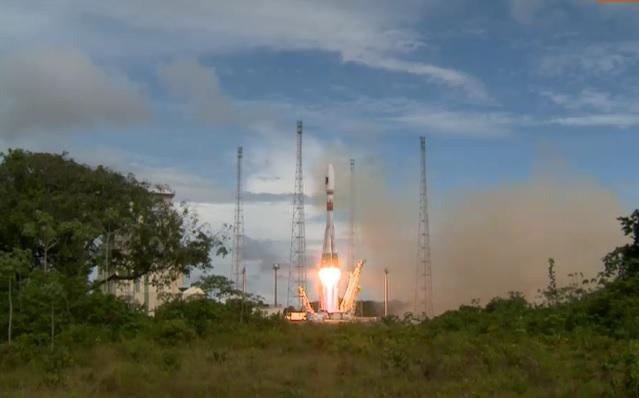
Many months of sustained effort goes into each and every Galileo launch, shown in this sequence of pictures selected from the four Galileo launches so far. The navigation payloads for each satellite are manufactured at Surrey Satellite Technology Ltd in the UK, which are then integrated to their satellite platforms at OHB in Germany. Next comes the rigorous test campaign to ensure the satellites can operate as planned in space, which takes place at ESA’s ESTEC Test Centre in the Netherlands.

The four-stage Soyuz ST-B launcher which deploys each pair of Galileo satellites into medium-Earth orbit is constructed in Russia, then sailed from St. Petersburg to Europe’s Spaceport in French Guiana. Once the Galileo satellites have passed testing they are transported by air to French Guiana, so the proper launch campaign can begin. The first three stages of the Soyuz are assembled horizontally, then raised vertically onto the launch pad. Read more…
Galileo 9 &10 reach European Spaceport

Ninth and tenth Galileo satellites have crossed the Atlantic, touching down in French Guiana ahead of their joint launch this September. The delicate navigation satellites made their journey within environmentally controlled containers, having passed a gamut of tests to confirm their readiness for space.

The pair left ESA’s ESTEC technical centre in Noordwijk, the Netherlands, last Thursday by road to Luxembourg Findel Airport. On Friday morning the duo flew by Luxair 747 aircraft to Cayenne–Félix Eboué Airport in French Guiana, touching down at around midday local time. Read more…

QinetiQ develops GNSS receiver for Galileo PRS

QinetiQ has announced a major breakthrough in developing a robust navigation receiver which will support the new global navigation satellite system (GNSS) Galileo, and particularly the secured Public Regulated Service (PRS) which could become of great use to the shipping and ports sector.

QinetiQ’s new high-performance, next-generation GNSS receiver is multi‑constellation and multi‑frequency, and is designed to process encrypted signals from the Galileo PRS service as well as open services such as GPS. Read more…

Galileo 5 and 6 Recovery

On 22 August 2014, Europe’s fifth and sixth Galileo satellites were launched by a Soyuz rocket from Europe’s Spaceport in French Guiana, continuing the construction of the Galileo satnav constellation.

Galileo launch - Soyuz VS09

Galileo launch – Soyuz VS09

The problem
At first, all seemed well. Then Galileo’s Launch and Early Orbit Phase (LEOP) team at ESA’s ESOC operations centre in Darmstadt (Germany), tasked with bringing the new satellites to life, jointly manned from ESA and French space agency CNES personnel, based at ESA’s ESOC operations centre in Darmstadt, raised the alarm. Read more…

New Galileo TT&C station in French Polinesia

The Spanish company Indra has been awarded a contract for the deployment in Papeete (French Polynesia) of a new Telemetry, Tracking and Command (TT&C) Station, which will expand the Galileo ground segment. This contract was awarded by Airbus Defence and Space in the UK. The project also includes the maintenance and evolution of all TT&C stations until 2016 for a global amount of €7.3M. The new TT&C station will join the two Uplink stations (ULS) already deployed by the same company in Papeete. Read more…

UTC adjusted by leap second addition

The Coordinated Universal Time (UTC) time standard, based on atomic clocks, is widely used for international timekeeping and as the reference for time in most countries. UTC is the basis of legal time for most of the world.

UTC must be adjusted at irregular intervals to maintain its correlation to mean solar time due to irregularities in the Earth’s rotation. These adjustments, called leap seconds, are pre-determined. Read more…