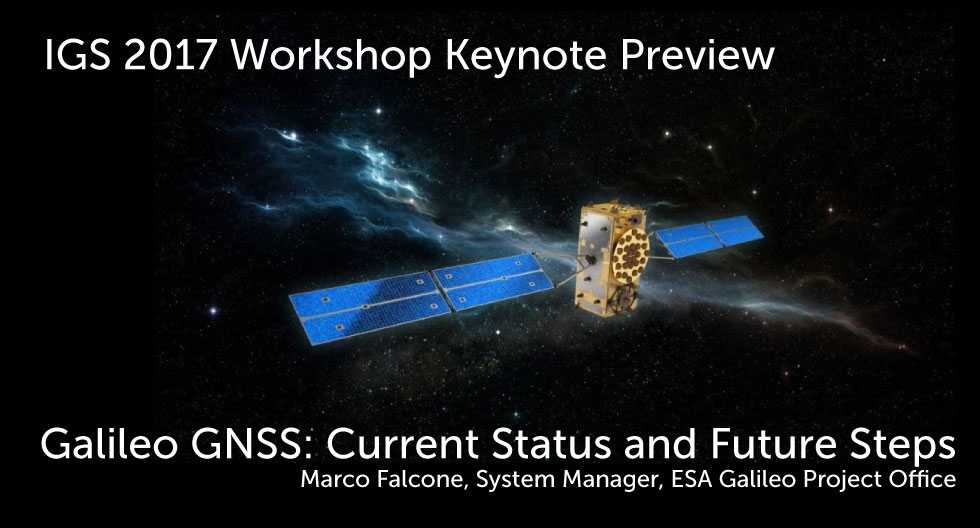
 This year, the IGS (International GNSS Service) Workshop will feature a special keynote lecture on the Galileo system, given by Marco Falcone of the European Space Agency (ESA). The keynote will address the current status of the now 18-satellite constellation, with special focus on the commissioning of the last four satellites, which were launched in November 2016. Overall system performance will also be discussed, including availability of signal in space, satellite ranging, positioning, and associated availability at the user level. Falcone will address timing performance with regard to Galileo System Time in contrast to UTC as well as GPS to Galileo Time Offset. He will also discuss the mission recovery of the GSAT201 and 202 satellites in elliptical orbit, plans for GSAT104 usage, satellite production, and the path ahead to full operation capaability. Read more…
IGS 2017 workshop
Leave a reply