EU Ministers for Transport, Infrastructure, and Communications meet on 4 and 5 December 2017 in Brussels to agree their position on an updated mandate for the Body of European Regulators for Electronic Communication (BEREC). Ministers also look at the progress made on a proposal on ePrivacy and discuss draft rules on the free flow of non-personal data. On Tuesday, the Council takes stock of the progress made on the mobility package proposals relating to market access and social aspects and discusses the road charging proposals. Ministers look at the progress made on the proposal to safeguard competition in air transport. The Council is also due to adopt three sets of conclusions.
The Council adopted conclusions on the report by the Commission containing a mid-term evaluation of Galileo, EGNOS and the performance of the European GNSS Agency. The conclusions underline the strategic importance of Europe’s satellite navigation systems and set out a number of recommendations on their implementation and evolution. Read more…
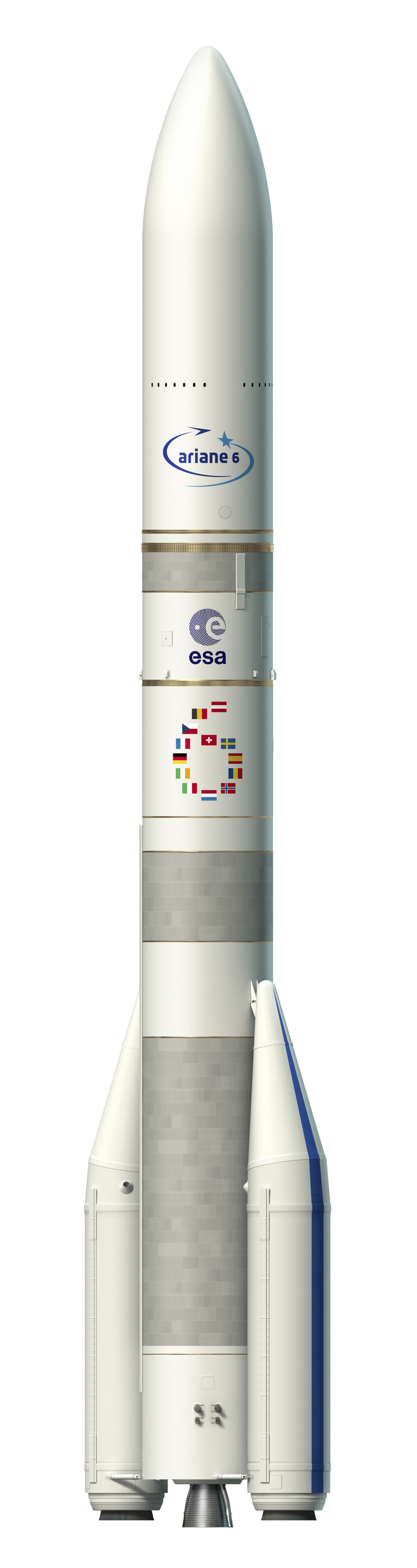
Four of the latest set of Galileo navigation satellites will be launched on Ariane 6 rockets – ESA’s first contract to use Europe’s new vehicle.
The launches are scheduled between the end of 2020 and mid-2021, using two Ariane 62 rockets – the configuration of Europe’s next-generation launch vehicle that is best suited to haul the two 750 kg navigation satellites into their orbits at 23 222 km altitude.
Under development, Ariane 6 is Europe’s newest launcher, designed to extend guaranteed access to space for Europe at a competitive price. It will operate in two configurations, depending on customer needs: Ariane 62 is fitted with two strap-on boosters while Ariane 64 has four.
“Ariane 6 is not only in full development, but it will soon be put to use,” notes Daniel Neuenschwander, ESA’s Director of Space Transportation. “This contract is a key step in the upcoming ramp-up phase of Ariane 6.”
The Galileos have so far either been launched in pairs by Soyuz from French Guiana or in fours by Ariane 5.
A new Ariane 5 flight is scheduled for the end of this year (12th December), to add four more satellites to the 18-strong constellation already in orbit. This month saw the arrival of the first elements of the rocket in French Guiana, transported aboard the MN Colibri roll-on/roll-off ship. Read more…
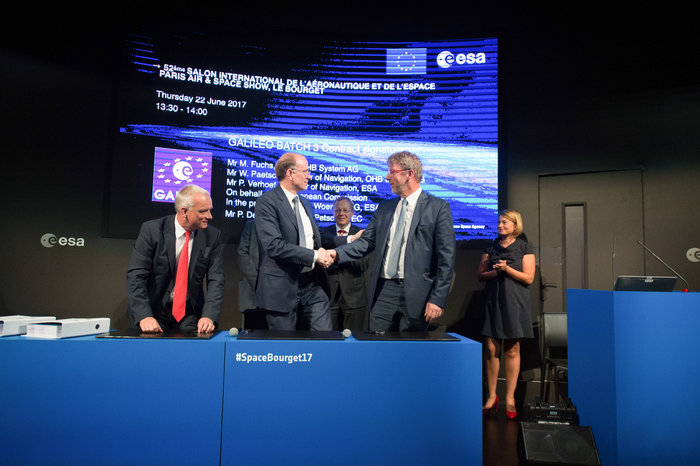
Europe’s Galileo navigation constellation will gain an additional eight satellites, bringing it to completion, thanks to a contract signed at the Paris Air and Space Show.
The contract to build and test another eight Galileo satellites was awarded to a consortium led by prime contractor OHB, with Surrey Satellite Technology Ltd overseeing their navigation platforms.
This is the third such satellite signing: the first four In Orbit Validation satellites were built by a consortium led by Airbus Defence and Space, while production of the next 22 Full Operational Capability (FOC) satellites was led by OHB. Read more…
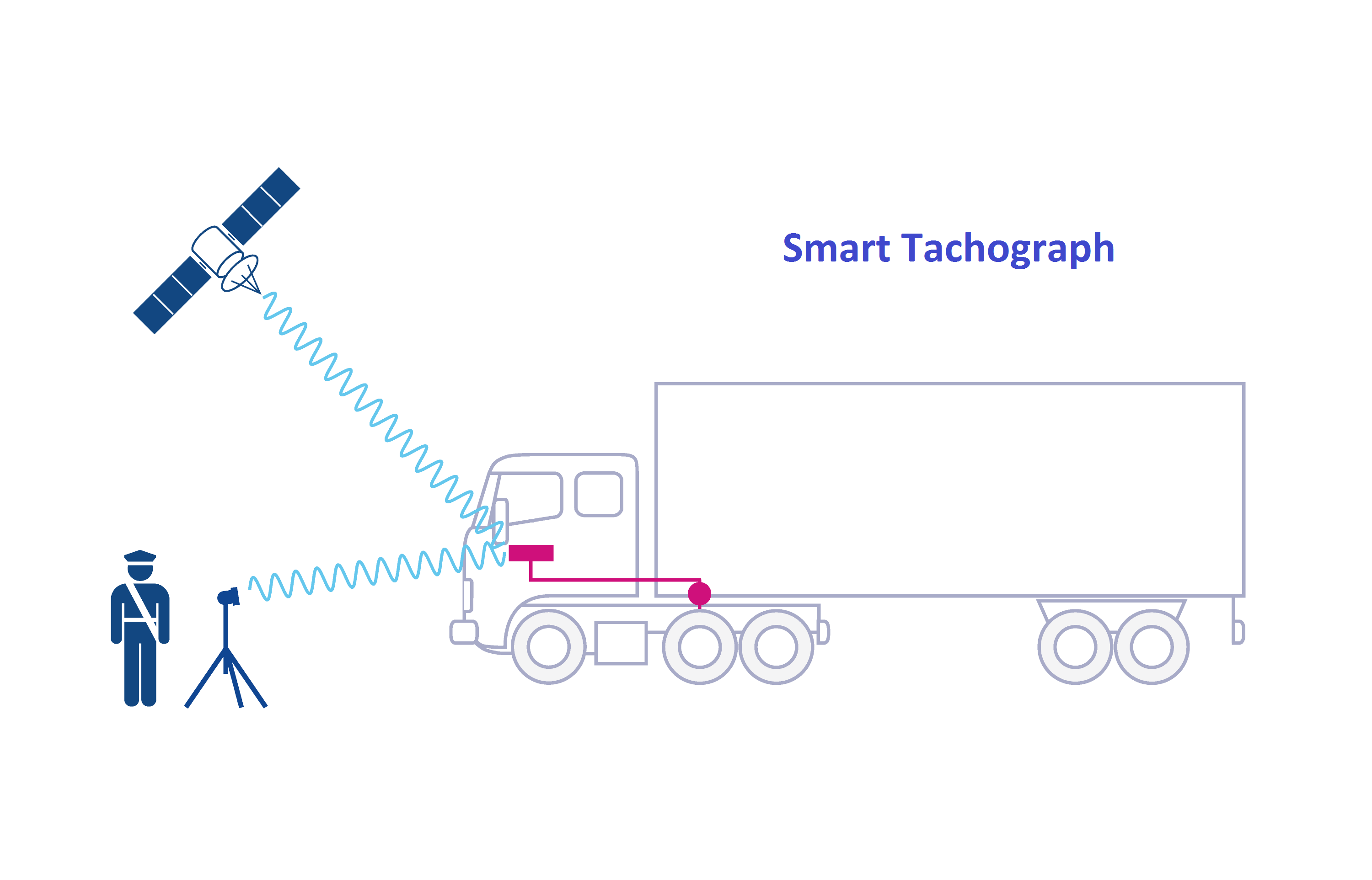
New Smart Tachograph security specifications have been prepared by the Joint Research Centre (JRC) for better enforcement of driving and resting times of heavy vehicle drivers to maximise road safety.
From 2019, all heavy vehicles must be equipped with a new Smart Tachograph, an improved version of the already existing digital tachograph which monitors and records the driving and resting times of professional drivers.
Smart Tachographs include a connection to the global navigation satellite system (“GNSS”) facility, a remote early detection communication facility, and an interface with intelligent transport systems, which will make it easier for authorities to track and identify potential offenders and detect fraud. Read more…
Vera Pinto Gomes, Space Policy Analyst at European Commission
The Disrupt Space 2017 brought the most promising space startups to meet with top investors and executives. This two-day event took place in Berlin and was fueled with business meetings, inspiring keynotes and hands on activities to foster collaboration towards building a sustainable space economy. Our colleague Vera Pinto Gomes* was on the Summit and presented the main highlights on the current and future status of EU space programmes that will benefit start-ups:
In 1957, only 12 years after the end of the Second World War, the Treaty of Rome was signed to forge a closer union among the people of Europe.
60 years later, Europe, working together, has accomplished things no European country could have done on its own, making life in Europe safer, sustainable and competitive.
We have advanced science, together we pushed back the frontiers of knowledge reached for the sky, expanded our capabilities and independene, and built systems that make a real difference for Europeans, the world and our planet.
Happy 60th birthday, Europe! Together we are stronger.
The GSA, along with the European Commission, invite all eCall device manufacturers, which are suppliers of the automotive industry, to participate and assess their eCALL devices’ capability to support the reception and processing of the Galileo and EGNOS signals. The GSA, along with the European Commission, invite all eCall device manufacturers, such as tier-1 suppliers, to participate and assess their devices’ capability to support the reception and processing of the Galileo and EGNOS signals.
The testing initiative follows the 17 January 2017 publishing of European Commission Delegated Regulation (EU) 2017/79. According to the regulation, all new M1 (passenger cars) and N1 (light duty vehicles) types must be equipped with eCall in-vehicle systems as of 31 March 2018. Read more…